Five Cognitive Biases That Undermine Leadership Decisions (And How To Coach Them)
By Will Salt ·
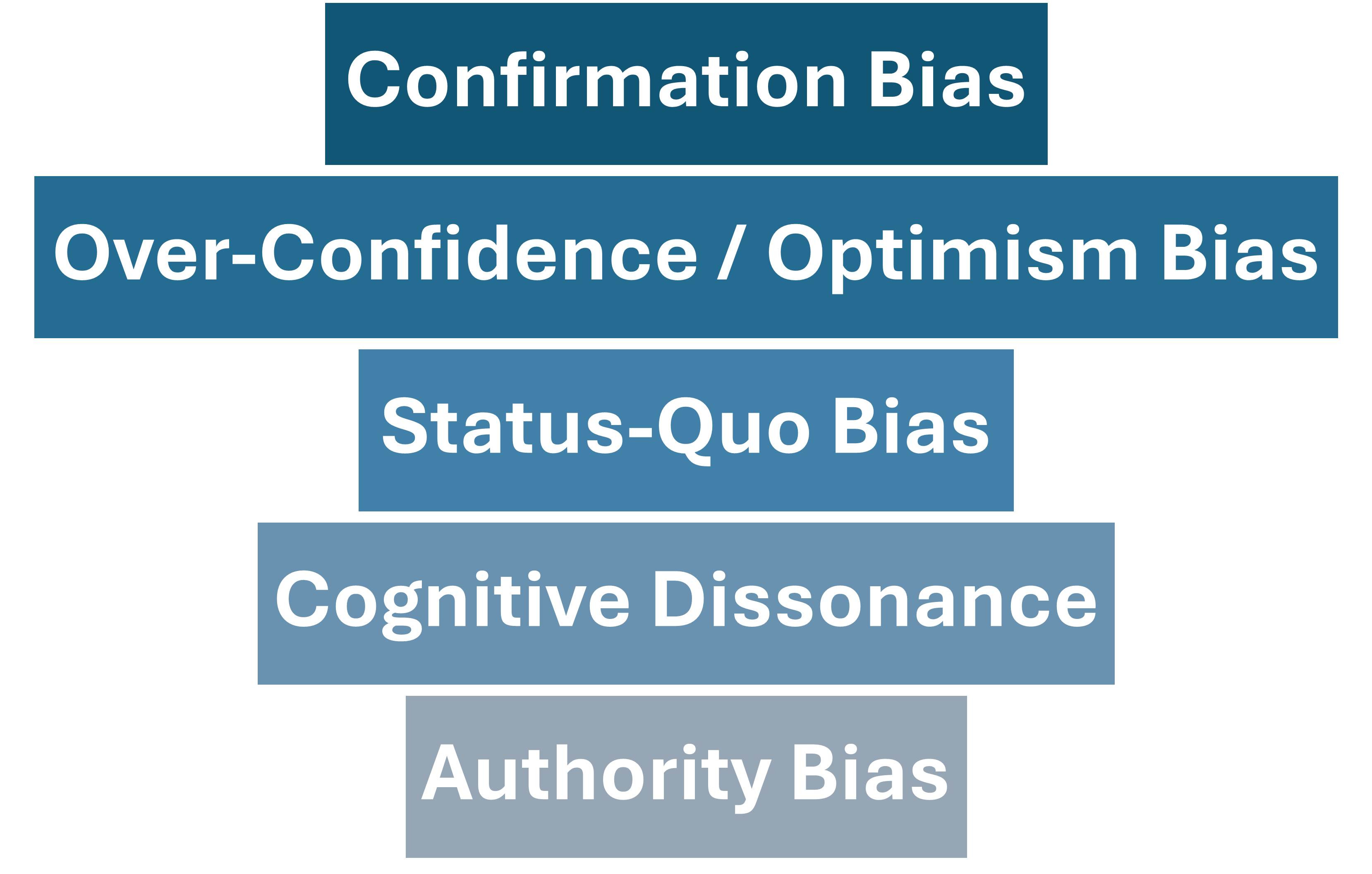
Even experienced leaders are not immune to flawed thinking. In fact, success and seniority can amplify certain cognitive biases that quietly erode decision quality, collaboration and performance.
This article explores five biases that show up repeatedly in leadership and professional environments, alongside practical questions you can use to examine your own thinking and coach better thinking in others.
1) Confirmation Bias
This is one for your executive team to watch. Years or decades of success can lead to complacency in thinking and decision making, trusting intuition or gut feeling without critically analysing the reality in front of them.
Confirmation bias is the reinforcement of existing beliefs, based on past successes, which then influences decision making. These mental shortcuts make it tempting to dismiss new ideas or data that contradict the new reality.
If your leaders often make decisions without gathering ideas from others and truly collaborating, personal blind spots can go unchecked, over time corrupting the decision-making process and ultimately your bottom line.
Blind Spots
The Johari Window captures this thinking succinctly. We all have blind spots, and it is your job as a leader to ensure you aren't preventing yourself from building awareness of your own.
Seeking feedback is essential to this process. The challenge for a leader with authority is working out how best to obtain it, given the responsibilities you carry and the power dynamics at play.
Q: When did you last obtain feedback on your performance, and how did you go about it?
Impression Management (The Fuel)
As a leader, you are surrounded by people who want to impress you and, if you are lucky, do right by you.
You will be aware that you must be intentional about what you say in certain circumstances, given your responsibilities. The same dynamic applies to junior staff in your presence. They will adapt and, except for a rare few, filter what they say with your role in mind, being sure not to say the "wrong" thing.
This dynamic can be most dangerous for leadership teams, and it can occur at any level. It is amplified the further apart the relative levels of authority are. Your people will be eager to please, and so are more likely to say what they think you want to hear than what they genuinely think.
When obtaining feedback, awareness of this cycle is essential:
- People say what they think leaders want to hear.
- Blind spots aren't identified.
- Leaders reinforce their confirmation bias.
Internal confirmation bias is reinforced by the external effects of authority bias and impression management. And so the cycle continues, until one day the affected decision making starts to take its toll.
Q: How are your leaders' blind spots being identified, tested and improved?
A Culture of Safety (The Solution)
Creating a culture of safety, where people can share their thoughts and opinions without being penalised, is essential to counter confirmation bias.
Q: If you do capture the ideas of wider staff, what processes do you have in place to act on them?
It's more important than ever to have younger staff contributing ideas and driving initiatives, as they are often closest to the latest technological developments and opportunities that could differentiate your company. Cutting graduate roles to save costs comes with the downside of losing the bright ideas, knowledge and experiences your younger people bring.
2) Overconfidence and Optimism Bias
Optimism bias leads us to expect positive outcomes. Overconfidence bias, often discussed alongside it, leads us to overestimate our ability to deliver on commitments.
It is well established that we tend to overestimate our abilities. The UK government's Green Book requires economic appraisals to apply upward adjustments to cost estimates for this very reason. Isn't it striking that some of the most thorough assessments need a rule of thumb to stop optimism bias interfering?
The reality is that this is part of being human, and we must accept and consciously work with it.
Pushing for business success is also part of human nature and forms the purpose of most organisations. So how do we balance the thirst for success with our innate tendency to expect good outcomes and overestimate our capabilities?
From a business perspective, taking on too many projects in pursuit of revenue will ultimately compromise reputation if deadlines are missed or client care can't cope. It's a fine line, and navigating it diligently is a challenge for leaders.
On a personal level, ego can inflate our sense of what we are capable of. We might find ourselves out of our depth in a role with greater responsibilities than we were ready for, leading to significant personal stress and poor performance.
We can just as easily overestimate what we can manage outside work, committing to too many social plans or overdoing our training, both of which can push us closer to overwhelm and burnout. We've all had a weekend with no plans and felt a quiet "thank goodness". If you have felt this recently, it may be a sign you are overestimating what you can healthily sustain.
3) Status Quo Bias
In a quickly changing world, a culture that has succumbed to status quo bias is a recipe for disaster. Doing things a certain way "because that's what we've always done" leaves companies lagging behind competitors. Blackberry and Blockbuster are familiar examples.
My first management job was a year in industry with Aldi, and I recall one of the management mantras being to ask staff, "Why are you doing it this way?"* Whilst "why" questions are generally cautioned against, as they can provoke defensiveness, the question highlights the need to stay curious, frequently, about the thinking behind what we do.
*An alternative you could try: "What was the thinking that led you to this conclusion?" It feels less challenging and invites the person to share their thinking process.
A reluctance to change could be rooted in avoiding difficult or unpopular decisions, the uncertainty of new ideas, or clinging to legacy.
You can only bury your head in the sand for so long before the tide comes in.
Q: Is the thinking behind this still relevant today? What might we be missing? What new information could offer better insight? If I were someone else, what would they think?
4) Cognitive Dissonance
Cognitive dissonance is the discomfort we feel when holding two or more conflicting truths at once, and the rationalisations we create to reduce that discomfort.
For example, you might have a senior leader who is damaging the company culture, and you're losing good people because of them. On the other hand, they bring in revenue, and removing them would be politically messy and financially costly.
Here there is a dissonance between values and consequences. It may lead to conclusions such as "we all have flaws" or "now isn't the time to deal with this".
Uncovering and accepting reality is a key element coaching can reveal about yourself, your situation or your thinking.
There are some things we just don't want to know or accept, either about ourselves and our capabilities, or about the reality of our situation. Emotional shortcuts make it tempting to bury our heads in the sand rather than face what's required. Inconvenient truths can affect us in many ways, inside and outside work.
If you suspect there is something you need to explore, your suspicion is probably correct. Choosing not to act on that hunch is a decision in itself, and its consequences will reveal themselves in time.
It may be uncomfortable, but if your aim is to grow or improve your performance, it is a process we have to go through.
Q: What might you be ignoring, or holding in dissonance?
Coaching can help you work through these more challenging matters safely, exploring the wider context and seeing new perspectives that help you identify corrective actions.
5) Authority Bias
If your culture defers too quickly to senior voices, you may be susceptible to authority bias. If this happens often, your leaders may develop an inflated sense of being right (confirmation bias). This can lead to shortcuts and overconfidence, and ultimately to poor decisions because the necessary work, wider discussion or involvement didn't happen.
It's this combination that undermines decision making at a deep, complex and often unnoticed level.
Q: How are you set up to hear ideas from those who don't like to be the loudest in the room?
Understanding your power dynamics, and who the loudest voices are, helps you find ways to balance the thinking and input of all your staff. Doing this well helps you avoid your own company echo chamber and supports your team to see, and act on, the truth.
Bringing It Into Practice
None of these biases disappears through awareness alone, but regular, honest reflection makes them easier to notice before they shape an important decision. That is one reason leaders use one-to-one coaching: a confidential space to test their thinking with someone outside their reporting line.
If you are considering this for leaders in your business, leadership coaching for organisations explains how it works, or you can book a conversation. For a related look at how pressure affects judgement, see What Sport Taught Me About Pressure At Work.
If this resonates, we could talk it through.
See how confidential one-to-one coaching can be set up for people in your organisation.
Related Reading
- Performance & Self-Management
What Sport Taught Me About Pressure At Work
Pressure is not the enemy of good performance; unprepared pressure is. Lessons from elite junior sport on handling pressure at work, preparation and recovery.
- Performance & Self-Management
Energy Is The Resource Nobody Puts In The Plan
Organisations plan time, budget and headcount in detail. Energy, which decides how well any of it gets used, rarely gets a line. Why that matters for sustainable performance.